Atlassian Statuspage is still the best-known status page tool, but in 2026 it's far from the only good option, and for many teams it isn't the best value. We compared eight Statuspage alternatives on features, limits and current pricing so you can pick the right one quickly.
Quick answer
- Best value overall: Statusentry — custom domain, 5,000 subscribers and built-in monitoring for $19.99/month.
- Best for a modern all-in-one public page: Instatus — generous Pro plan at $20/month, including SMS.
- Best if you also need on-call and observability: Better Stack — status pages as part of a larger monitoring platform.
- Best for many public and private pages: StatusPal — unlimited status pages on every plan.
- Best for large, globally distributed enterprises: Status.io — mature, feature-rich, priced accordingly.
- Best for uptime monitoring first, status page second: OnlineOrNot or UptimeRobot.
- Best free, self-hosted option: Upptime or Uptime Kuma, if you're happy to run it yourself.
| Tool | Paid plans from | Around 5,000 subscribers | Built-in monitoring | Private pages |
|---|---|---|---|---|
| Atlassian Statuspage (baseline) | $29/mo | $399/mo (Business) | No — via integrations | Separate plans from $79/mo |
| Statusentry | $9.99/mo | $19.99/mo (Business) | Yes, paid plans | No |
| Instatus | $20/mo | $20/mo (Pro) | Yes | Business plan ($300/mo) |
| Better Stack | Free tier, then add-ons | 1,000 per page included, +$40/mo per extra 1,000 | Yes | Password auth add-on ($50/mo per page) |
| StatusPal | $46/mo | 4,000 on Business ($299/mo) | Yes | From Startup ($99/mo) |
| Status.io | $79/mo | $349/mo (Plus) | Via integrations | — |
| OnlineOrNot | $15/mo (Pro) | Unlimited email subscribers on Pro | Yes | +$48/mo per page |
| UptimeRobot | $12/mo (Solo, billed yearly) | — | Yes (core product) | — |
| Upptime / Uptime Kuma | Free (open source, self-hosted) | Not built in | Yes | No |
Why teams look for Statuspage alternatives
Atlassian Statuspage is reliable and full-featured, with deep ties to Jira Service Management and Opsgenie. But its public page plans scale steeply: Free (100 subscribers, 2 team members), Hobby $29, Startup $99, Business $399 and Enterprise $1,499 per month. Webhook and SMS notifications start on the $99 plan, and private pages are a separate product.
The most common reasons teams switch:
- Cost: paying $99–$399 per month for what is, for many teams, a public page with a few components.
- Seat and subscriber limits: team member caps (2 to 50) force awkward sharing of logins.
- Monitoring is separate: you need another tool to know something is down before you post about it.
- Complexity: many teams don't need the Atlassian ecosystem to post an incident update.
How we compared
- Status page essentials: components, incidents, scheduled maintenance, uptime history, custom domain.
- Notifications: email, Slack, webhook, SMS and how they're gated by plan.
- Monitoring: whether the tool can detect downtime itself.
- Price at realistic limits: what you actually pay for around 1,000 and 5,000 subscribers.
- Ease of use: how quickly someone on call can post a clear update.
The 8 best Statuspage alternatives in 2026
1. Statusentry
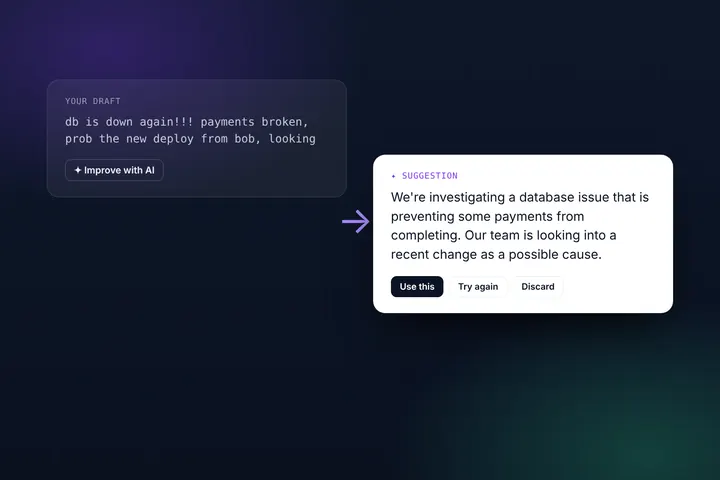
Statusentry is a hosted status page focused on doing incident communication well and affordably. You get components, incidents, scheduled maintenance, uptime history, email/Slack/webhook subscribers, posts to X (Twitter), a status badge and a REST API — plus built-in endpoint monitoring and an AI writing assistant for clearer updates.
Key strengths
- Lowest price at the same limits: 5,000 subscribers and 25 team members for $19.99/month — the same limits Atlassian charges $399 for.
- Big top plan: Enterprise includes 50,000 subscribers and unlimited team members for $39.99/month.
- Monitoring built in: HTTP checks every 5 minutes to 24 hours with email and Slack alerts on failure and recovery.
- Simple: anyone on the team can post an update without training.
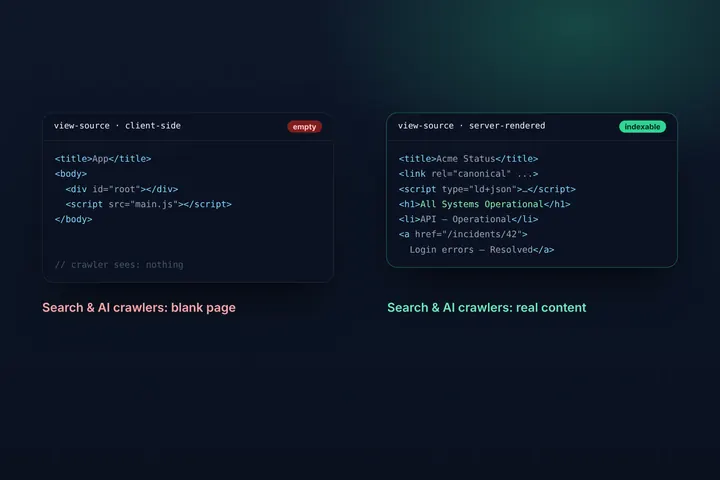
- SEO-friendly: public status and incident pages are server-rendered so search engines and AI assistants can read them.
Pricing
- Free: $0 — 1 team member, 2 services, no subscribers
- Start Up: $9.99/month — 10 team members, 1,000 email/webhook subscribers, API, monitoring
- Business: $19.99/month — 25 team members, 5,000 subscribers incl. Slack, custom domain
- Enterprise: $39.99/month — unlimited team members, 50,000 subscribers
Best for: start-ups, SMBs and IT teams that want a polished public status page, notifications and monitoring without enterprise pricing.
Watch out for: no SMS or Microsoft Teams notifications, no private or audience-specific pages yet, and the free plan doesn't include subscribers.
2. Instatus
Instatus is a popular, modern status page tool known for fast pages and a generous mid-tier plan. It includes uptime monitors and supports public, private and audience-specific pages on higher plans.
Key strengths
- Strong Pro plan: $20/month for 5,000 subscribers, 50 team members, 50 monitors and a custom domain.
- SMS included on Pro: email and SMS notifications.
- Free tier: 200 subscribers, 5 team members and 15 monitors.
Pricing
- Starter: free — 200 subscribers, 5 team members, 15 monitors
- Pro: $20/month — 5,000 subscribers, 50 team members, 50 monitors, custom domain
- Business: $300/month — 25,000 subscribers, 1,000 monitors, private and audience-specific pages
- Enterprise: custom. Yearly billing is 25% off.
Best for: teams that want a modern public page with SMS at a low price.
Watch out for: a large jump from $20 to $300/month once you need private pages or more than 5,000 subscribers.
3. Better Stack
Better Stack is an observability platform — uptime monitoring, on-call, incident management and logs — with status pages as one part of it. Pricing is modular: you start free and add what you need.
Key strengths
- All-in-one: monitoring, on-call scheduling and status pages in one product.
- Free to start: 10 monitors, 10 heartbeats and 1 status page.
- Phone and SMS alerts for responders on paid seats.
Pricing
- Free: 10 monitors, 1 status page, Slack and email alerts
- Extra status page: $15/month; 1,000 subscribers per page included, +$40/month per extra 1,000
- Responder seats with unlimited phone and SMS alerts: $34/month each
- Add-ons per page include password protection ($50/month), custom CSS/JS ($15/month) and removing the “Powered by Better Stack” footer ($250/month)
Best for: engineering teams that want monitoring, on-call and a status page from one vendor.
Watch out for: add-on pricing makes costs harder to predict, and branding-related add-ons get expensive.
4. StatusPal
StatusPal is a status page platform aimed at growing and mid-size companies, with unlimited status pages on every plan, built-in monitoring and private pages from the Startup plan.
Key strengths
- Unlimited status pages on every plan — useful for multiple products or regions.
- Private pages from the $99 Startup plan.
- Monitoring included: 10 to 100 monitored services depending on plan.
Pricing
- Hobby: $46/month — 500 subscribers, 5 team members, public pages
- Startup: $99/month — 1,000 subscribers, 20 team members, 1 custom domain
- Business: $299/month — 4,000 subscribers, 50 team members, 4 custom domains
- Enterprise: custom
Best for: companies running several status pages, including private ones.
Watch out for: no custom domain on the entry plan, and subscriber limits are lower than others at similar prices.
5. Status.io
Status.io is one of the longest-running status page providers, built for larger organizations with complex, global infrastructure. Every plan includes a public status page with a custom domain.
Key strengths
- Enterprise focus: mature product with advanced customization and integrations.
- Custom domain on every plan.
- Higher team limits: up to 50 team members on Plus.
Pricing
- Basic: $79/month — 500 subscribers, 5 team members
- Standard: $149/month — 2,000 subscribers, 20 team members
- Plus: $349/month — 5,000 subscribers, 50 team members
- Annual billing: 5% off
Best for: large enterprises that want a long-established vendor.
Watch out for: one public status page per plan and the highest entry price on this list.
6. OnlineOrNot
OnlineOrNot is an uptime and browser-check monitoring service with status pages built in. It is developer-friendly, with fast checks and a low entry price.
Key strengths
- 30-second checks and browser checks on Pro.
- Unlimited email subscribers and team members on Pro.
- Wide alerting: email, Slack, Discord, Telegram, SMS, webhooks and on-call integrations on Pro.
Pricing
- Hobby: free — 3 monitors, 3-minute checks, 1 limited status page, 100 email subscribers
- Pro: from $15/month — 10 monitors (+$10 per 25 more), 1 status page with custom domain (+$24 per extra page), private pages +$48/page
- Enterprise: custom. Yearly billing gives two months free.
Best for: developers who mainly want monitoring and need a clean status page alongside it.
Watch out for: extra status pages and private pages are paid add-ons, so costs grow with each page.
7. UptimeRobot
UptimeRobot is one of the most widely used uptime monitoring services. Status pages come with every plan, which makes it a common low-cost choice for teams that mostly care about monitoring.
Key strengths
- Generous free plan: 50 monitors at 5-minute intervals and a status page, for hobby and non-profit projects.
- Cheap paid plans with faster checks and your own domain on the status page.
- Integrations: Slack, Microsoft Teams, Telegram and more; webhooks, Zapier and PagerDuty from Team.
Pricing (billed yearly)
- Free: $0 — 50 monitors, 5-minute checks, 1 status page
- Solo: $12/month — 60-second checks, 3 status pages, custom domain
- Team: $39/month — 100 monitors, 30-second checks, 100 status pages, 3 seats
- Scale: $79/month — 15-second checks, unlimited status pages, 5 seats
Best for: teams that want inexpensive monitoring with a simple public status page.
Watch out for: the status page is secondary to monitoring. Incident write-ups, scheduled maintenance and subscriber communication are less central than in dedicated status page tools.
8. Upptime and Uptime Kuma (open source)
If budget is zero and you have engineering time, two open-source projects are popular. Upptime runs entirely on GitHub Actions and GitHub Pages. Uptime Kuma is a self-hosted monitoring app with built-in status pages.
- Cost: free software. You pay for (and maintain) the hosting.
- Strengths: full control, no vendor lock-in, active communities.
- Watch out for: you own uptime of the status page itself. If it runs on the same infrastructure that's down, your status page goes down with it. Subscriber emails, custom domains with SSL and team access are things you set up yourself.
How to choose
- You want the lowest cost for a professional public page: Statusentry or Instatus.
- You need SMS or Microsoft Teams notifications: Instatus (SMS on Pro), Better Stack (responder alerts) or Atlassian Statuspage.
- You need many pages or private pages: StatusPal, or Instatus Business.
- You want monitoring, on-call and status in one product: Better Stack.
- Monitoring is the priority and the status page is secondary: OnlineOrNot or UptimeRobot.
- Zero budget, engineering time available: Upptime or Uptime Kuma.
- You're deep in the Atlassian ecosystem: staying on Statuspage may be simplest.
- You want monitoring and the status page together, at the lowest price for 5,000+ subscribers: Statusentry.
Head-to-head comparisons: Statusentry vs Instatus · Statusentry vs StatusPal · Statusentry vs Better Stack · Statusentry vs OnlineOrNot.
Statusentry vs Atlassian Statuspage in one line
At the same subscriber and team limits, Statusentry costs 90–97% less — and adds built-in monitoring. See the full Statusentry vs Atlassian Statuspage comparison for a feature-by-feature table and how to switch, or open our demo status page.
Ready to try it? Create a free account — new accounts get a 30-day Enterprise trial, no credit card required.