Generative AI has made building software dramatically faster. Features that took a sprint now take an afternoon. But one thing hasn't sped up at all: how much your customers trust you when something breaks. That trust is earned in the minutes after an incident starts — through clear, honest communication.
How generative AI changed software development
In just a few years, AI has gone from autocomplete to a working partner in almost every part of the development process. Developers now use it to write and refactor code, generate tests, explain unfamiliar codebases, draft documentation, review pull requests and turn a rough idea into a working prototype.
Adoption has been fast. In the 2025 Stack Overflow Developer Survey, 84% of respondents said they use or plan to use AI tools in their development process, up from 76% the year before, and about half of professional developers use them every day.
The effect is easy to feel on any team:
- Prototypes in hours, not weeks. Small teams can ship products that once needed a much bigger engineering group.
- More releases. When code is cheaper to write, teams ship more often and in larger batches.
- Less time on boilerplate. Engineers spend more of their day on product decisions and less on glue code.
- New dependencies. Many products now call AI model APIs and other third-party services in their critical path.
Faster shipping means more change — and more ways to break
Speed has a cost. Google Cloud's 2024 DORA report found that AI is boosting individual productivity, documentation quality and code review speed. But it also estimated that a 25% increase in AI adoption was associated with a 7.2% reduction in delivery stability.
That matches what developers say. In the same Stack Overflow survey, more developers distrusted the accuracy of AI output (46%) than trusted it (33%). And the most common frustration, named by 66%, was AI solutions that are “almost right, but not quite.” “Almost right” code passes a quick review, ships, and fails at 2 a.m. under real traffic.
None of this is a reason to stop using AI. It's a reason to accept a simple fact: if you ship more, faster, you will have incidents. A bad deploy, an edge case nobody tested, a third-party API that times out, an AI provider having a bad day. The question isn't whether something will break. It's how your customers experience it when it does.
What doesn't get faster: customer trust
Customers rarely remember the root cause of an outage. They remember how it felt. Did they find out from you, or from their own users? Did they have to open a ticket to learn what was going on? Did the updates sound calm and specific, or vague and defensive?
AI can help you write code faster. It can't make your customers trust you faster. That still comes from how you show up when things go wrong.
Good incident communication does three things at once:
- It reduces support load. One status update answers hundreds of “is it down?” tickets before they're written.
- It buys your engineers time. When customers know you're on it, the pressure on the people fixing the problem drops.
- It protects the relationship. Teams that communicate well during incidents often come out with more trust than before, not less.
What good incident communication looks like
You don't need a big process. You need a few habits, applied every time:
- Acknowledge fast. Post a first update within minutes, even if you don't know the cause yet. “We're investigating” is far better than silence.
- Say what's affected in plain language. “Checkout is failing for some EU customers” beats “degraded performance in a subsystem.”
- Set the next update time. “Next update in 30 minutes” gives people a reason to stop refreshing — and you a deadline to keep.
- Update even when there's no news. “Still working on it, no change yet” keeps trust; long gaps destroy it.
- Close the loop. Say when it's resolved, what happened in one or two sentences, and what you'll change.
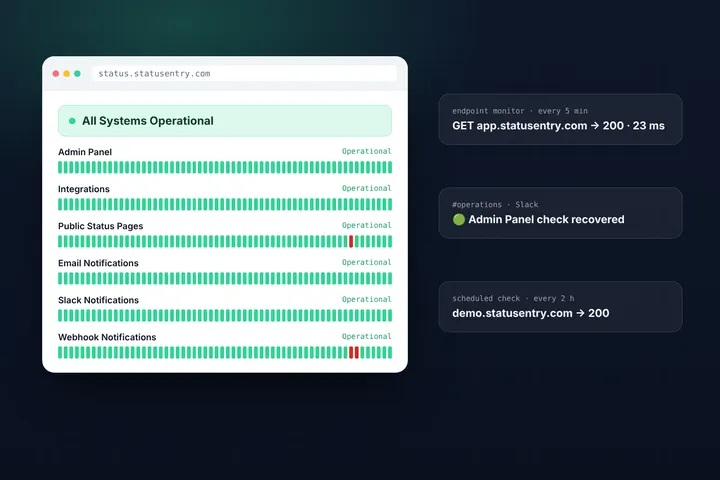
- Reach people where they are. A status page plus email, Slack and webhook notifications means customers don't have to come looking.
- Own it. Don't blame a vendor, a model or “the AI.” Customers bought your product; the incident is yours to explain.
A simple update template
- Investigating: “We're seeing errors on checkout for some customers and are investigating. Next update in 30 minutes.”
- Identified: “A change to tax calculation is causing failed payments for EU customers. We're rolling it back now.”
- Monitoring: “The rollback is complete and payments are succeeding again. We're monitoring closely.”
- Resolved: “Checkout has been working normally for 60 minutes. Some EU payments between 14:05 and 14:48 UTC failed; affected customers can retry. We're adding a test for this case.”
Use AI for incident communication too — carefully
The same tools that speed up development can help during an incident. Writing a clear, calm update while production is on fire is hard; AI is good at turning rushed notes into readable sentences. That's why Statusentry includes an AI writing assistant that refines incident titles and update messages with one click.
Two rules keep it safe:
- Facts come from your team, not the model. Let AI improve the wording, never guess the cause, the impact or the timeline.
- A human publishes. Read every update before it goes out. You're accountable for what your status page says.
A practical setup for AI-era teams
- A hosted status page with your services grouped the way customers think about your product — including third-party and AI-powered parts they depend on.
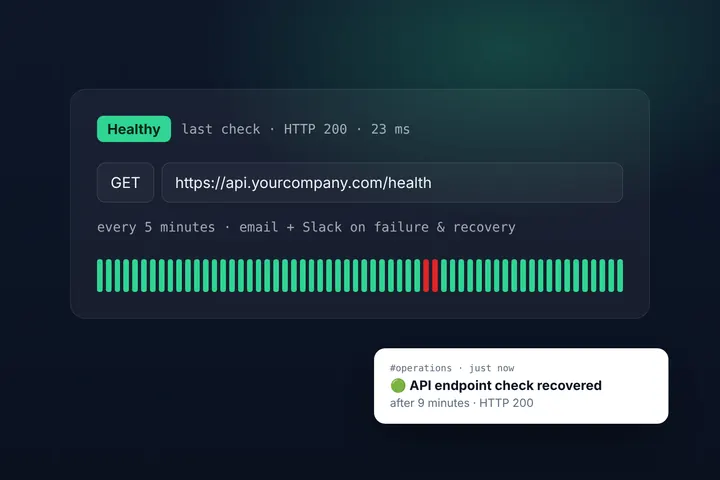
- Monitoring that catches failures first. Built-in endpoint monitoring can check your key URLs every few minutes and alert your team in email and Slack before customers notice.
- Subscribers on every channel: email, Slack and webhooks, so updates reach people automatically.
- Clear ownership. Decide in advance who posts the first update. Ideally anyone on call can do it in under a minute.
- A habit of publishing. Public incident history is proof you take reliability seriously. We do it ourselves.
Ship fast, communicate well
Generative AI is the biggest change to how software gets built in a generation, and teams that use it well will move faster than ever. The teams that keep their customers will be the ones who pair that speed with honest, timely communication when things go wrong.
If you want a simple way to do that, create a free Statusentry account — set up your status page, connect your channels and be ready before the next incident. You can also see what customers would see on our demo status page.